
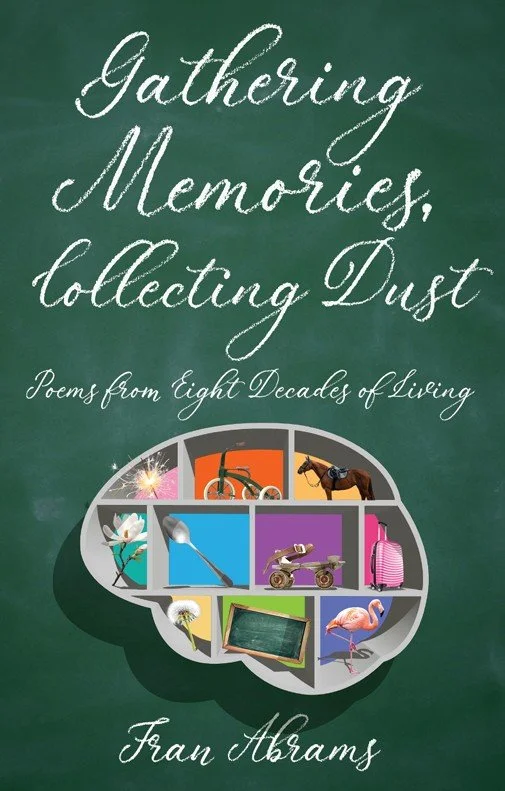
This book is available to purchase from Amazon.com in Kindle, paperback, and hardcover formats, from Bookshop.org, from BarnesandNoble.com in paperback and hardcover and many other fine book retailers.
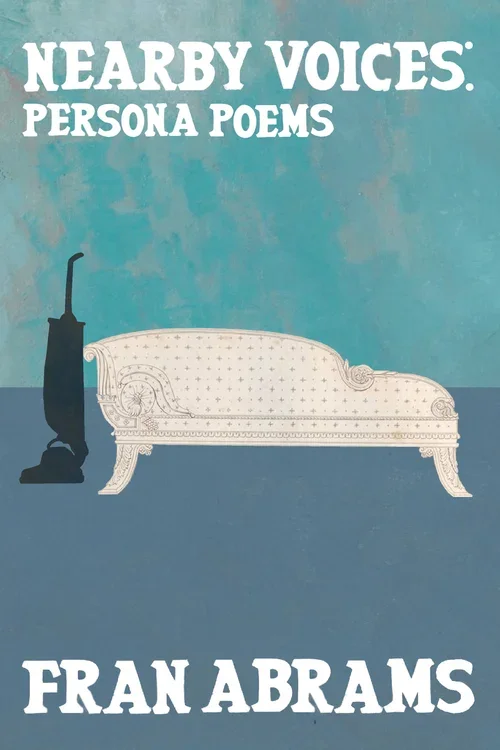
The book is $10 plus shipping and is available only from the publisher at https://bottlecap.press/products/nearfa.
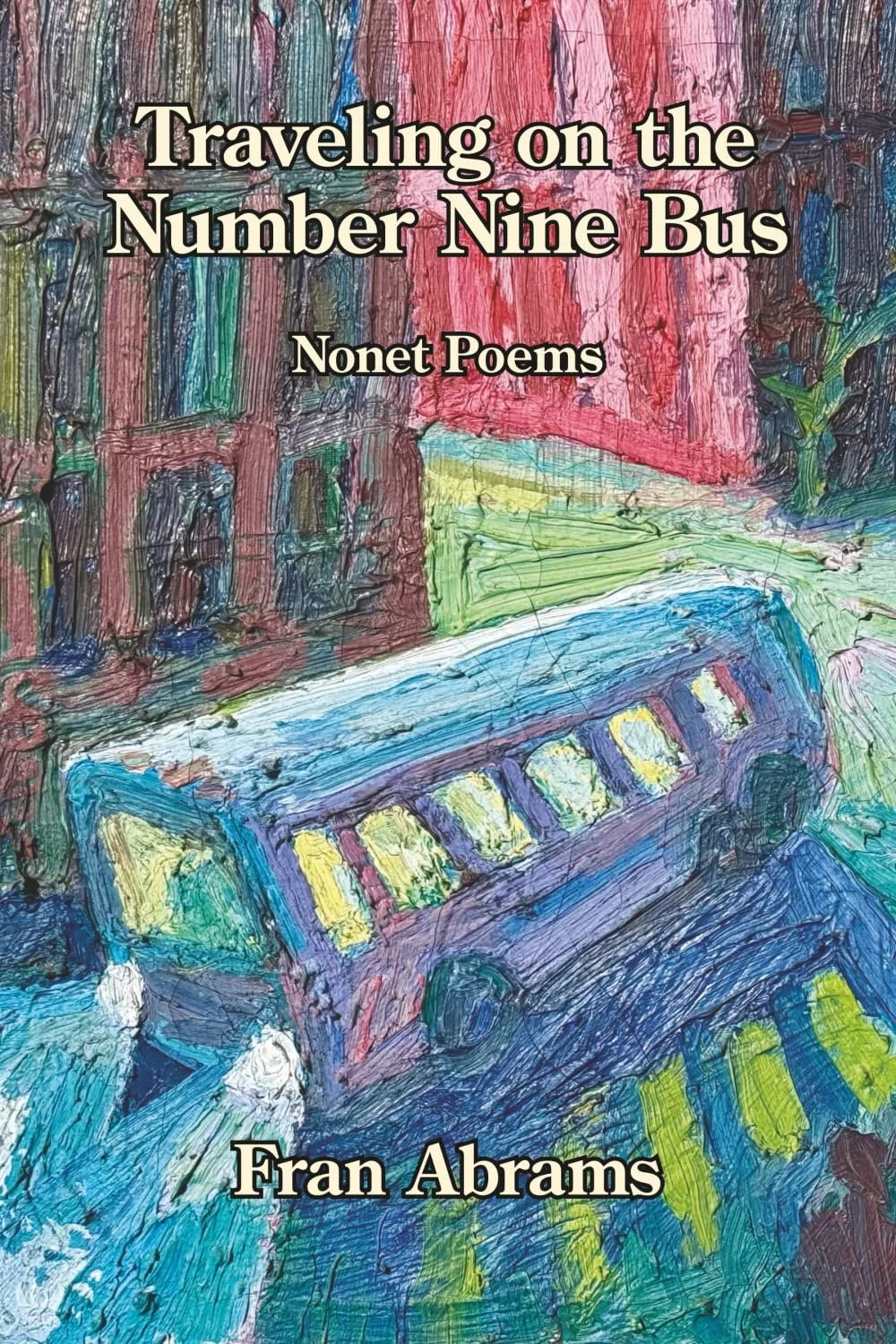
The book is available to purchase from the publisher--Kelsay Books, or Bookshop.orgor Amazon, for $20 plus tax and shipping. Also available as a Kindle edition for $9.99 at Amazon.

Arranging Words is available to purchase at bookshop.org, barnesandnoble.com, and in paperback and Kindle at Amazon.com, as well as at many other fine bookstores.

I Rode the Second Wave: A Feminist Memoir is an autobiographical story told in poetry through the eyes of a woman whose life paralleled the second wave of feminism, a movement that began in the 1960’s and focused on equal opportunities and equal pay for women.
The second wave changed the expectations of women from the homemakers of the 1950’s to career women. The author was a freshman in college in 1962 determined to enter the workforce in a professional position. After completing her graduate degree in 1969, she was rebuffed in job interviews by men who assumed she would leave her job soon after she married and had children. She accepted a job in an office where she was the only professional woman. She married in 1970, had her first child in 1976 and her second in 1984. She worked for 41 years, retiring in 2010.
Placing her story in the context of women’s marches and feminist goals, the author tells how she grew up in a world that expected women to become homemakers and how she combined her desire for a professional career with marriage and motherhood at a time when mothers with careers were just starting to be accepted in our culture.
Published by Atmosphere Press, November 2022.
Look for it wherever books are sold, including: Bookshop.org, Barnes and Noble, Amazon
Gathering Memories, Collecting Dust--Poems from Eight Decades of Living was released in August 2026 from Atmosphere Press, a month after Fran's 82nd birthday. More than eighty years of living are captured in this warm, wise collection that spans three decades of women. From the safe brick apartments of 1950s Washington, DC, to the frantic pace of motherhood and the quiet realizations of grandmotherhood, this collection uncovers the extraordinary in the everyday. Whether it's the mystery of an abandoned box of Nancy Drew books, the "ammonia-scent" of a first-time home permanent, or the bittersweet experience of the "sandwich generation," these poems invite us to retrieve our own memories. It is a celebration of a life well-loved, reminding us that while time may erase the chalkboard, the heart keeps the score.
Published by Atmosphere Press, August 2026.
My fifth book of poetry titled Nearby Voices: Persona Poems has been published by Bottlecap Press. In this book, inanimate objects tell us their personal narratives and tales of woe. In a persona poem, the author speaks through a voice other than the poet’s own. For example, the speaker may be a historical figure or a cartoon character. The invented voice is part of what pulls us into the poems.
In this collection, the characters whose voices we hear are the objects we see each day in our homes—including our sofa, dining table, and the baby’s crib, and in our neighborhood—such as the grocery store, gas station, and ATM. Each provides a perspective on our everyday lives that we may not have considered until we look at these speakers’ joys, needs, and worries. We learn about the carpet that loves to be vacuumed, the washing machine that’s disgusted by its family’s eating habits, and the stop sign that prides itself on preventing accidents. These poems, told from the point of view of objects we’re not accustomed to “listening” to, are a refreshing look at our everyday lives.
Published by Bottlecap Press, December 2025.
Traveling on the Number Nine Bus is written entirely in Nonet or reverse Nonet form. Each Nonet poem is nine lines long and follows a syllable count of nine syllables in the first line, eight syllables in the second line, seven syllables in the third line, and so on. Reverse Nonet poems begin with one syllable. I've used this form to tell the story of a bus traveling a route through an unnamed city, its passengers, its driver, the places it goes, as well as the secrets on the bus. It is a chronicle of everyday people that rely on the bus. Even if you don't regularly use the bus, you'll enjoy the stories of the riders, their quirks and their challenges, all written in poetry.
Published by Kelsay Books, September 2025.
Arranging Words, a chapbook of 32 poems, is my second chapbook collection. Like my earlier chapbook, The Poet Who Loves Pythagoras, this book is a series of light-hearted poems that asks the reader to look at the world from a new perspective. These poems approach letters, words, and everyday phrases in a way that pokes fun at the eccentricities of the English language.
For example, a poem titled “K Knows How to Hide and Seek” begins with the line “K knocks twice, but we only hear him once,” reminding us how often “k” is a silent letter. The poem “Poetry Exercise” plays on the meaning of the word “exercise” with the line “Brain cells stretch, lift your arms, reach for words.” Phrases are deconstructed into literal meanings, such as in the poem “Beside Myself” that asks, “Am I myself or the one beside myself?” This collection illuminates the quirks of the English language in a lively, humorous way while demonstrating an everlasting love for words.
Published by Quillkeepers Press, October 2023.

Look for it wherever books are sold, including: Bookshop.org, Barnes and Noble, Amazon
Fran loves Pythagoras because his theorem always works, whereas life does not offer much that is certain. In her book The Poet Who Loves Pythagoras, you'll read poems like “Ice Cubes,” that explain relative density as you watch cubes float in your glass of scotch. Algebra helps you decide whether to buy that candy bar. Percentages are simply fractions with fancy symbols. With titles like “Poetry is a Word Problem,” “Define Infinity,” and “Solve My Life,” these poems will have you appreciating poetry, math, and science from a refreshingly different perspective.
Poet Sandra Beasley says of this book, “Readers who prize the consideration of big questions, balanced against agile specificity of phrase, will delight in this quirky collection.”
Poet Jona Colson says of Fran’s book, “In the aptly titled collection, The Poet Who Loves Pythagoras, Fran Abrams gives us a surprising perspective: the poet and the mathematician. In the first poem ‘Pythagorean Theorem,’ she writes, ‘Few things in life are certain,’ but we are certain of her talent and craft.”
Published by Finishing Line Press, March 2023.